Journal article · Scientific Reports 2021
OpenEP: An Open-Source Simulator for Electroporation-Based Tumor Treatments
Scientific Reports 11, 1423 (2021) · Springer Nature
Matías Marino and Emmanuel Lujan contributed equally to this work.
Abstract
Electroporation (EP), the increase of cell membrane permeability due to the application of electric pulses, is a universal phenomenon with a broad range of applications. In medicine, some of the foremost EP-based tumor treatments are electrochemotherapy (ECT), irreversible electroporation, and gene electrotransfer (GET).
The electroporation phenomenon is explained as the formation of cell membrane pores when a transmembrane cell voltage reaches a threshold value. Predicting the outcome of an EP-based tumor treatment consists of finding the electric field distribution with an electric threshold value covering the tumor (electroporated tissue). Threshold and electroporated tissue are also a function of the number of pulses, constituting a complex phenomenon requiring mathematical modeling.
We present OpenEP, an open-source specific purpose simulator for EP-based tumor treatments, modeling among other variables, threshold, and electroporated tissue variations in time. Distributed under a free/libre user license, OpenEP allows the customization of tissue type; electrode geometry and material; pulse type, intensity, length, and frequency.
OpenEP facilitates the prediction of an optimal EP-based protocol, such as ECT or GET, defined as the critical pulse dosage yielding maximum electroporated tissue with minimal damage. OpenEP displays a highly efficient shared memory implementation by taking advantage of parallel resources; this permits a rapid prediction of optimal EP-based treatment efficiency by pulse number tuning.
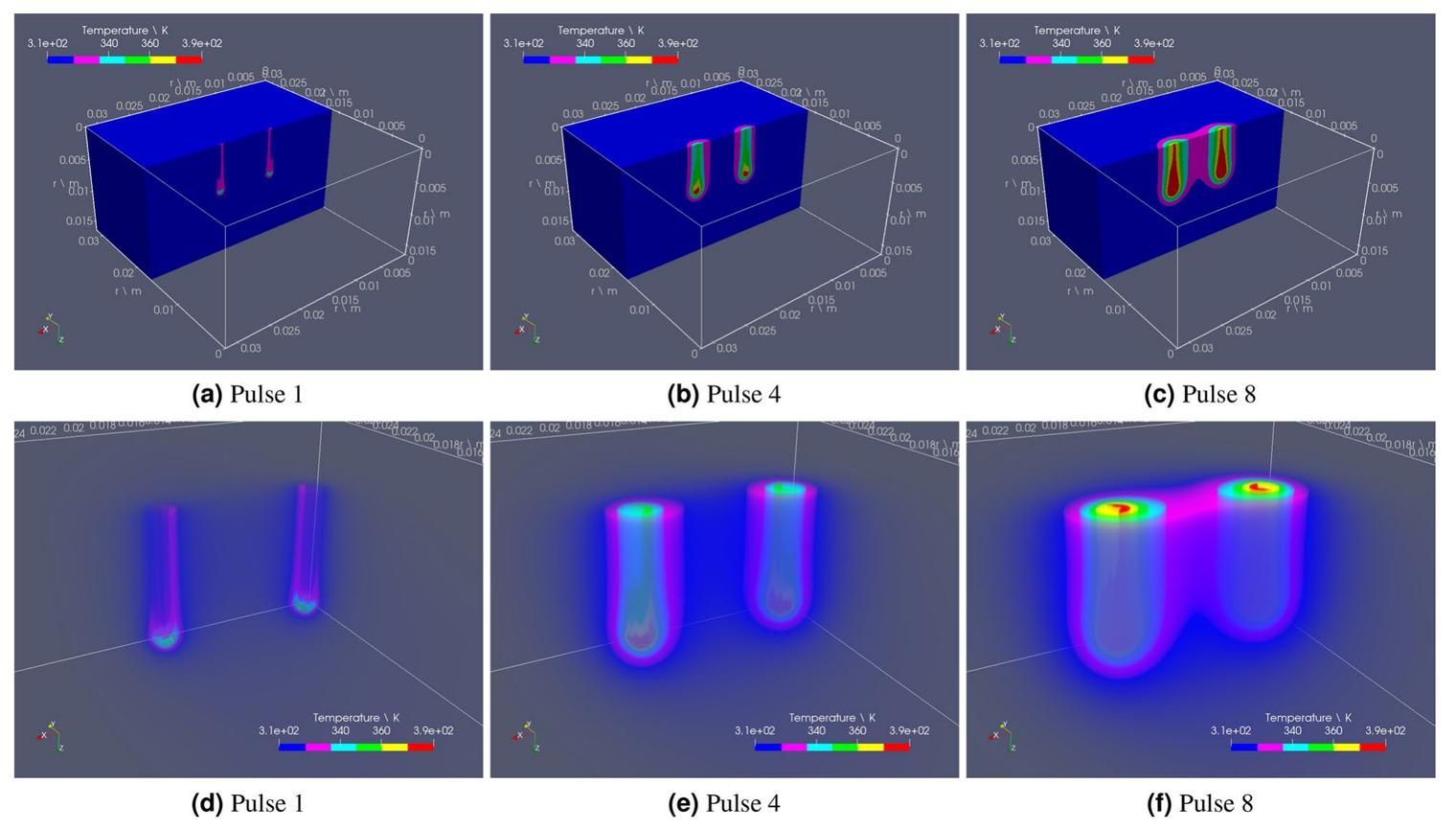
Published open access in Scientific Reports under a Creative Commons Attribution 4.0 International licence; the full text is read from the version of record at Springer Nature. The figure below is reproduced under that same licence.
Cite this paper
Download .bib ↓Matías Marino, Emmanuel Lujan, Esteban Mocskos and Guillermo Marshall, “OpenEP: An Open-Source Simulator for Electroporation-Based Tumor Treatments,” Scientific Reports, vol. 11, art. 1423, 2021.
doi:10.1038/s41598-020-79858-y
@article{marino2021openep,
  title={{OpenEP}: An Open-Source Simulator for Electroporation-Based Tumor Treatments},
  author={Marino, Mat{\'{i}}as and Lujan, Emmanuel and Mocskos, Esteban and Marshall, Guillermo},
  journal={Scientific Reports},
  volume={11},
  number={1},
  pages={1423},
  year={2021},
  publisher={Springer Nature},
  doi={10.1038/s41598-020-79858-y},
  url={https://doi.org/10.1038/s41598-020-79858-y}
}